The cordon sanitaire in Belgium: an anti-democratic lock serving the traditional parties!
The cordon sanitaire is not simply a political device. It is a democratic lock-in mechanism allowing traditional parties to maintain power indefinitely by silencing other movements!
The cordon sanitaire is not a simple political mechanism. For Révolution, this disgracefully named “sanitary” cordon – as if those placed within it were disgusting, unworthy and almost monstrous individuals – is a mechanism of democratic lock-down allowing traditional parties to maintain power over time by silencing all other movements!
Two centuries of confiscated power
Since 1830, Belgium has been governed by the same major political families: the Christian Democrats (who for the past 30 years have been striving to erase their Christian values in order to conform to Masonic secularism), the liberals and the socialists. Behind changes of names, logos and coalitions, the reality is simple: it is always the same people who are in charge!
For nearly 100 years, Catholics and liberals shared power. After 1945, the socialists entered the game. Since then, these three families have never left the center of power.
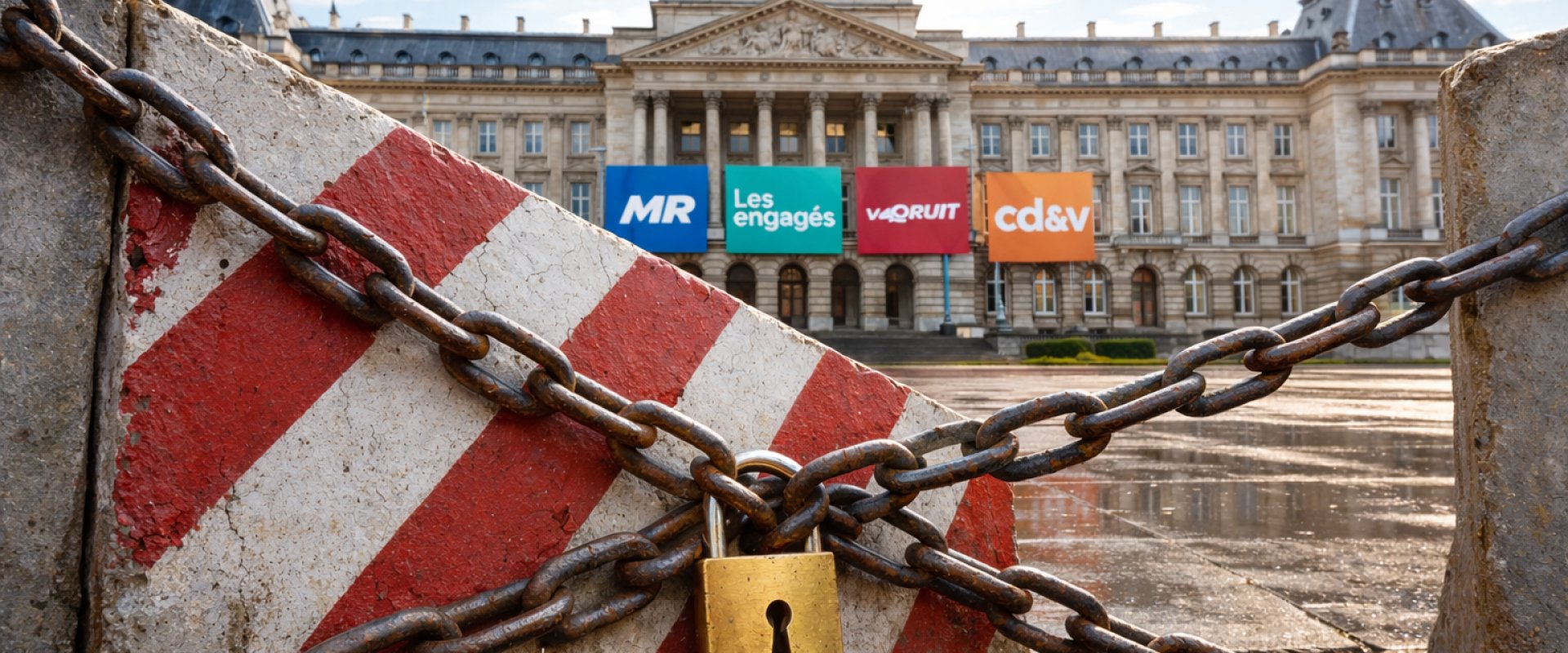
Even today, in the government led by Bart De Wever’s N-VA and sometimes presented as a break with the past, the power structure remains dominated by traditional parties: MR, Les Engagés, Vooruit, CD&V
- Traditional parties remain overwhelmingly dominant and indispensable.
- Without them, no government can exist.
- This is not a real democratic alternation, but an internal management of power among established actors.
The cordon sanitaire: a political invention to block democracy
At the end of the 1980s, faced with the rise of Vlaams Blok, traditional parties became afraid. Instead of convincing voters and countering the ideas and proposals of Vlaams Blok, they changed the rules of the game: they invented the cordon sanitaire.
Since 1989–1991, this mechanism has imposed a simple rule: some parties may be elected, but they will never be allowed to govern...
A disturbing reality: no democratic basis
The political cordon sanitaire rests on a brutal truth: it exists in no law!
The cordon sanitaire is not based on any text voted by Parliament, on any constitutional obligation, nor on any formal democratic rule.
It is in reality a simple agreement between parties. A pact. An arrangement. A lock. The traditional parties have decided among themselves in advance who has the right to govern, and who will never have it.
In any other field, this would be called collusion. In politics, it is called a “cordon sanitaire”.
The media cordon: filtering speech
The political lock was not enough. It was also necessary to control the debate. In French-speaking Belgium, public media such as RTBF apply a media cordon sanitaire:
- limited access to certain broadcasts;
- absence of live debates;
- differentiated treatment depending on the parties.
Officially, this is justified by the fight against racism, the protection of democracy or certain CSA rules. But in reality, it comes down to one thing: some parties are deemed acceptable and others not, in advance. The media no longer inform; they use their position to shape public opinion by completely ignoring certain movements or political figures. This is no longer journalism, it is activism, it is propaganda!
Voters can vote, but they do not hear all voices in the same way. They see representatives of power on television every day but never hear about censored movements. And even if voters vote “wrong” and support the “unacceptable”, it changes nothing in power, since once again the political cordon sanitaire will apply...
A two-speed democracy
The cordon sanitaire creates a deeply unequal situation: not all votes are equal.
- Voting for a traditional party: possibility of governing.
- Voting for an “outsider” party: no real consequence on power.
The people vote, but the parties then decide which votes truly count. Millions of votes can thus be neutralized for decades. This is exactly what happens with parties such as Vlaams Belang, regularly very strong electorally but systematically excluded.
The real role of the cordon: protecting the system!
The cordon sanitaire is often presented as a moral tool. “Good democrats protect democracy from the bad ones!”. Yet such logic is deeply anti-democratic. In a democracy, all ideas must be allowed to be expressed, and no one should arbitrarily decide who is or is not a good democrat, because logically it is up to the people to decide independently!
In reality, the cordon sanitaire is a political survival tool that allows:
- to prevent the emergence of new actors in power;
- to keep traditional parties at the center of the game;
- to block any real political recomposition.
Without this mechanism, the Belgian political landscape would be completely different. Some majorities would become impossible without the excluded parties, and traditional parties would lose their monopoly.
A fundamental contradiction and a guilty hypocrisy
Traditional parties claim to defend democracy. Yet at the same time, they refuse to collaborate with elected parties, filter access to the media and decide in advance which coalitions are possible.
Traditional parties defend democracy only on the condition that it changes nothing. They have decided that democracy is them and no one else, thereby creating a dictatorship that does not say its name!
The contradiction is total: if voters vote “correctly”, the system works; if they vote “wrong”, their choice is neutralized.
Even worse, hypocrisy is fundamentally present regarding the cordon sanitaire. Traditional parties are quick to label as “far-right” any emerging movement likely to take votes from them. And since these parties have no access to the media, it is impossible for the average citizen to see through the deception. These lies distort democracy and should shame those who manipulate public opinion to such an extent. However, it is a reality, and Laurent LOUIS is a striking example! Although he is one of the greatest humanists and democrats in this country, his political opponents portray him as a low-level extremist, and the Belgian press never gives him a voice...
Should this system be maintained?
The real question is not moral, it is democratic: who decides in a democracy? The voters, or the political parties in power?
Today, the answer is clear: it is the parties that filter the results of elections!
Conclusion: an unavoidable debate
The cordon sanitaire has existed for more than 35 years. Presented as temporary, it has become permanent. Meanwhile, distrust in institutions is growing, the gap between citizens and politics is widening, and the feeling of democratic injustice is taking root.
More and more citizens are asking a simple question: what is the point of voting if certain choices are forbidden in advance?
The cordon sanitaire is no longer a detail of the Belgian political system. It has become one of its pillars. And that is precisely why the debate over its maintenance or its abolition is becoming unavoidable.
Our proposal
Our proposal is clear: the so-called “cordon sanitaire” must be declared anti-democratic and completely abolished. It has no real democratic basis. It is merely an agreement between ruling parties, an arrangement among insiders to remain in power over time and stifle political competition.
To definitively break this locked system, it is necessary to:
- abolish the 2/3 majority rule, which makes deep constitutional reform almost impossible;
- abolish the cordon sanitaire, which is misleading and anti-democratic;
- demand that public and private media finally give a voice, live and without censorship, to all political movements.
Freedom of expression must apply to everyone, not only to traditional parties!