Rediscovering our Christian roots: a necessity for the future of Belgium!
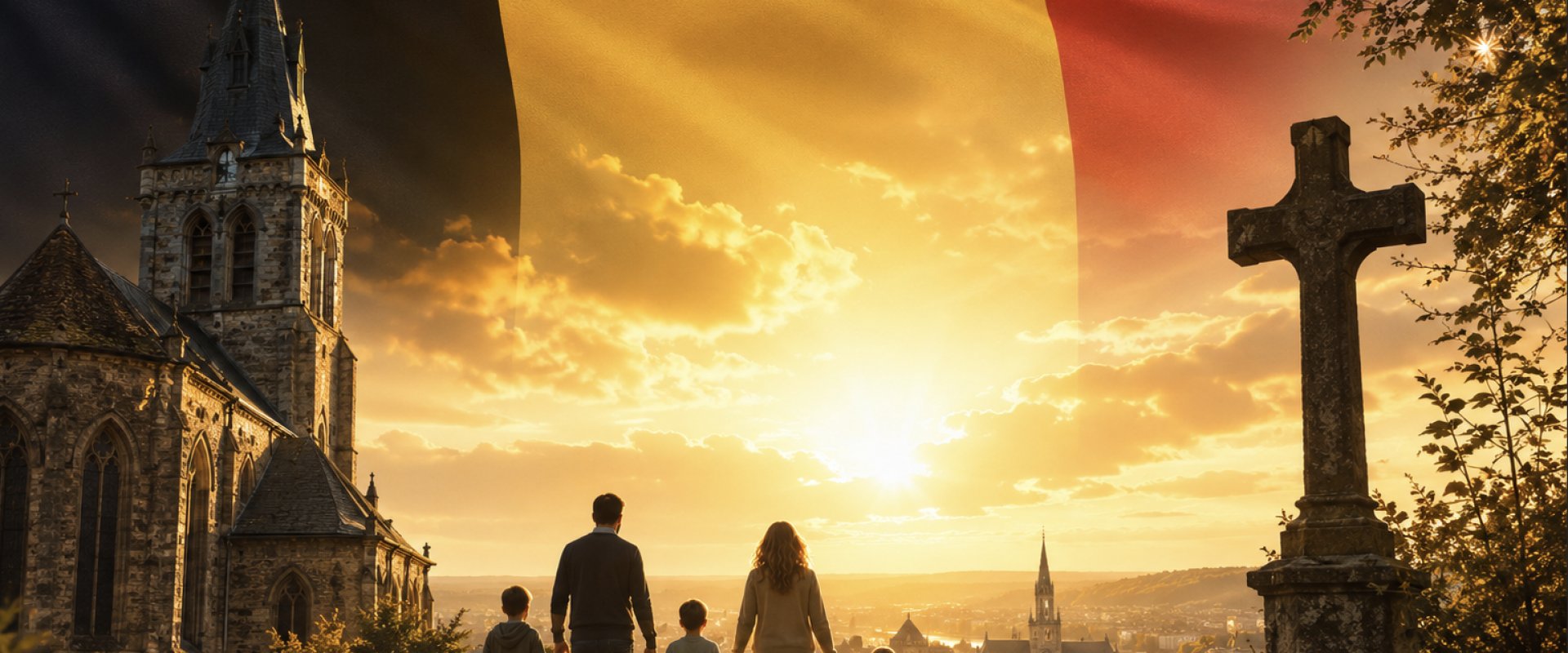
Belgium is a country whose history, culture, traditions, and institutions have been profoundly shaped by Christianity. Our cities, our towns, our festivals, our understanding of human dignity, solidarity, and justice still bear the imprint of this heritage today.
A freedom to believe that exists in theory, but is declining in practice
While freedom of worship is protected by our Constitution, many citizens feel that openly expressing their Christian faith has become more difficult than it once was. Not because the law forbids it, but because a cultural pressure is exerted against those who wish to live their faith publicly.
How many people today hesitate to speak about their faith at work, at school, or in the media for fear of being labelled as backward, conservative, or trapped in an “old-fashioned mentality”? How many young believers prefer to remain silent rather than face ridicule or misunderstanding from those around them?
Yet a genuine democracy should not distinguish between respectable convictions and those that have become embarrassing. It should guarantee everyone the right to live and express their beliefs with respect for others.
The name of Jesus Christ should never be a subject of mockery. Whether one is a believer or not, He remains one of the most important figures of our civilization. His teachings have inspired generations of Belgians and continue to provide meaning, hope, and guidance to millions of people throughout the world.
Respect for diversity also implies respect for believers. A society that claims to be tolerant cannot regard the Christian faith as a relic of the past or an object of ridicule.
School: a place of transmission or the erasure of our heritage?
The issue of education deserves particular attention. For several decades, religious education classes have gradually lost their place and visibility in many schools. Students are often asked to choose between different subjects, including religious education, non-confessional ethics, or other citizenship-related courses. In practice, the choice is often made very quickly. Religious education classes are frequently viewed as a secondary option, even though they should be considered an essential component in transmitting our cultural and spiritual heritage.
In some schools, Christian religious education classes sometimes have only a handful of students. It is not uncommon for groups to be extremely small, or even for no class to be organized in certain years due to insufficient enrolment. This reality should concern us collectively.
This is not about eliminating freedom of choice for families or imposing religious practice. Freedom remains a fundamental principle. However, it is legitimate to question why the teaching of Christianity, which shaped our national history for centuries, seems to be increasingly pushed into the background.
How can we expect younger generations to understand the history of Belgium, Europe, our institutions, our artistic heritage, or our traditions if they no longer know the religious foundations that shaped them?
A society that ceases to transmit its heritage inevitably loses part of its identity. Christianity is not merely a matter of personal faith; it is also one of the keys to understanding our history and our civilization.
Is a society without the sacred condemned to lose its bearings?
Beyond the religious question itself, it is the place of the sacred in our society that deserves to be examined.
For several decades, Europe has experienced profound secularization. Religious references occupy an increasingly marginal place in public life. Many consider this evolution inevitable, or even desirable.
Yet it is legitimate to ask what the consequences may be. When a society no longer recognizes any transcendent dimension, when it no longer regards anything as truly sacred, it risks gradually losing its fundamental points of reference. Values become relative, fluctuating, and subject to the ideological fashions of the moment.
A civilization cannot live solely on consumption, technology, and material comfort. It needs a vision of humanity, a moral compass, and an ideal that transcends individual interests.
Christianity long provided this moral framework for our society. It reminded us that every human being possesses intrinsic dignity, that there is a difference between good and evil, that freedom also entails responsibilities, and that the pursuit of the common good must prevail over individual selfishness. As these references gradually fade, other values take their place.
Some of these may be positive. Others may lead to a society that is increasingly individualistic, fragmented, morally degraded, and deprived of stable points of reference.
When God gradually disappears from the collective horizon, the vacuum thus created never remains unoccupied for long. Other references, ideologies, and systems of values naturally take His place. Some may be beneficial, but others may lead to a vision of humanity in which everything becomes relative, traditional moral landmarks are constantly questioned, and nothing seems truly untouchable anymore.
A society that no longer recognizes any form of transcendence risks gradually losing its sense of limits. What was once considered unthinkable becomes debatable, then acceptable, and eventually may become the new norm. Democratic debate remains necessary, but it is legitimate to question the consequences of a civilization that no longer rests upon any shared spiritual foundation.
Paradoxically, many of our fellow citizens today perceive a profound malaise. They denounce the loss of values, growing individualism, loneliness, the crisis of authority, and difficulties in passing traditions and values from one generation to another. They sense that something has become fragile within the moral fabric of our society. Yet few are willing to consider that the distancing from the sacred may be part of the cause.
We often wish to recover the fruits without returning to the roots that produced them. We want to preserve the values of solidarity, respect, responsibility, and human dignity inherited from Christianity while gradually forgetting the source that gave birth to them and nourished them for centuries.
It is enough to listen to everyday conversations to realize that a malaise exists. Many citizens say that “something is no longer right.” They speak of the loss of values, the lack of respect, isolation, the crisis of authority, difficulties in transmission, and the rise of individualism.
Yet few dare to ask whether the gradual distancing from the sacred may be part of the problem.
Fighting Masonic secularism
For several generations, certain ideologies have sought to confine faith to the private sphere and gradually erase all spiritual references from public life. In the name of an increasingly radical conception of secularism, religious beliefs have often been presented as obstacles to progress or as realities that should disappear over time.
Révolution opposes this vision. We reject an imposed secularism, promoted in particular by certain networks of influence linked to Freemasonry, which gradually leads our societies to believe in nothing except the god of money, consumption, and the relentless pursuit of profit. A civilization cannot survive in the long term when it replaces its spiritual values with materialism and individualism. On the contrary, we believe that faith, whatever form it takes, constitutes an essential source of moral, human, and social balance for our nation.
The youth's quest for meaning: the unexpected return of spirituality
Although secularization appears to have been progressing for several decades, another, more discreet phenomenon also deserves our attention. While religious institutions have lost many followers, more and more young people today are expressing a search for meaning, stability, and transcendence.
This reality is reflected in particular by the increase observed in recent years in the number of adult baptisms in several European countries, including Belgium. These initiatives are especially significant because they involve individuals who freely choose to turn toward faith at an age when they are fully aware of their commitment, following the example of Jesus Christ.
This phenomenon reveals a deep aspiration that our modern society seems to struggle to satisfy. Despite technological progress, improved material comfort, and almost unlimited access to information, many young people experience a feeling of emptiness, uncertainty, or a loss of direction.
Our era often encourages individual success, consumption, and the immediate satisfaction of personal desires. Yet human beings do not live on material goods alone. They also need meaning, belonging, transmission, and hope.
The spiritual search that is reappearing among some young people should not be perceived as a nostalgic return to the past. It can be understood as a natural reaction to the limitations of a society that sometimes struggles to answer the great questions of existence: Why live? Why make sacrifices? How can one build a life that has lasting meaning?
Faced with these questions, many people discover or rediscover Christianity not as a constraint, but as a source of answers, guidance, and coherence. They find in it a vision of humanity that goes beyond the sole logic of performance or consumption.
This observation should challenge us. While our society sometimes tends to regard religion as an outdated reality, part of the younger generation seems instead to be seeking in spirituality what it can no longer find elsewhere: an identity, a community, a hope, and a reason to believe in something greater than themselves.
Perhaps this is a sign that the religious question has never truly disappeared. Perhaps we are simply witnessing the return of a fundamental human need: the need to give meaning to one's existence and to be part of a reality greater than oneself.
Reconciling modern freedom and Christian heritage
Defending Belgium's Christian roots does not mean imposing a state religion or returning to a bygone era.
It means reminding ourselves that our heritage deserves to be respected, transmitted, and embraced.
It means defending the right of believers to live their faith without being ridiculed.
It means restoring a genuine place for religious transmission within education.
It also means recognizing that the spiritual dimension of human existence cannot be erased without consequences for the balance of our society.
Tomorrow's Belgium must remain a land of freedom. A freedom for those who believe and for those who do not. But this freedom must not lead to the systematic erasure of the Christian identity that shaped our nation.
We can be fully rooted in the twenty-first century while still embracing our heritage.
We can defend freedom while recognizing the value of the sacred. We can look toward the future without denying the foundations upon which our civilization was built.
Rediscovering our Christian roots is not a step backward. It is the desire to reconnect with the values, transmission, and meaning that helped shape our country for centuries.
For a nation does not live solely through its economy, technology, or institutions. It also lives through memory, values, and hope. If we wish to pass on something more than a standard of living to future generations, we must have the courage to transmit what shaped our civilization.
Embracing our Christian roots is not an act of exclusion. It is an act of fidelity to our history, confidence in our heritage, and hope for the future.
Uniting the believers of Belgium
Révolution wishes to bring together all believers in Belgium around what unites them rather than what divides them. We respect the different religious practices and believe that believers often share common values: respect for family, transmission, solidarity, a sense of duty, love of one's neighbour, and the pursuit of the common good. That is why we call on Christians and Muslims in Belgium to work together to defend the place of faith in our society, preserve the Christian roots that shaped our country, and pass on a living spiritual heritage to future generations. We believe it is possible to be both a believer and a patriot, deeply attached to one's faith as well as to one's nation. Our ambition is to help build a Belgium where believers, whatever their faith tradition, fully participate in the defence of our identity, our culture, and our common future!