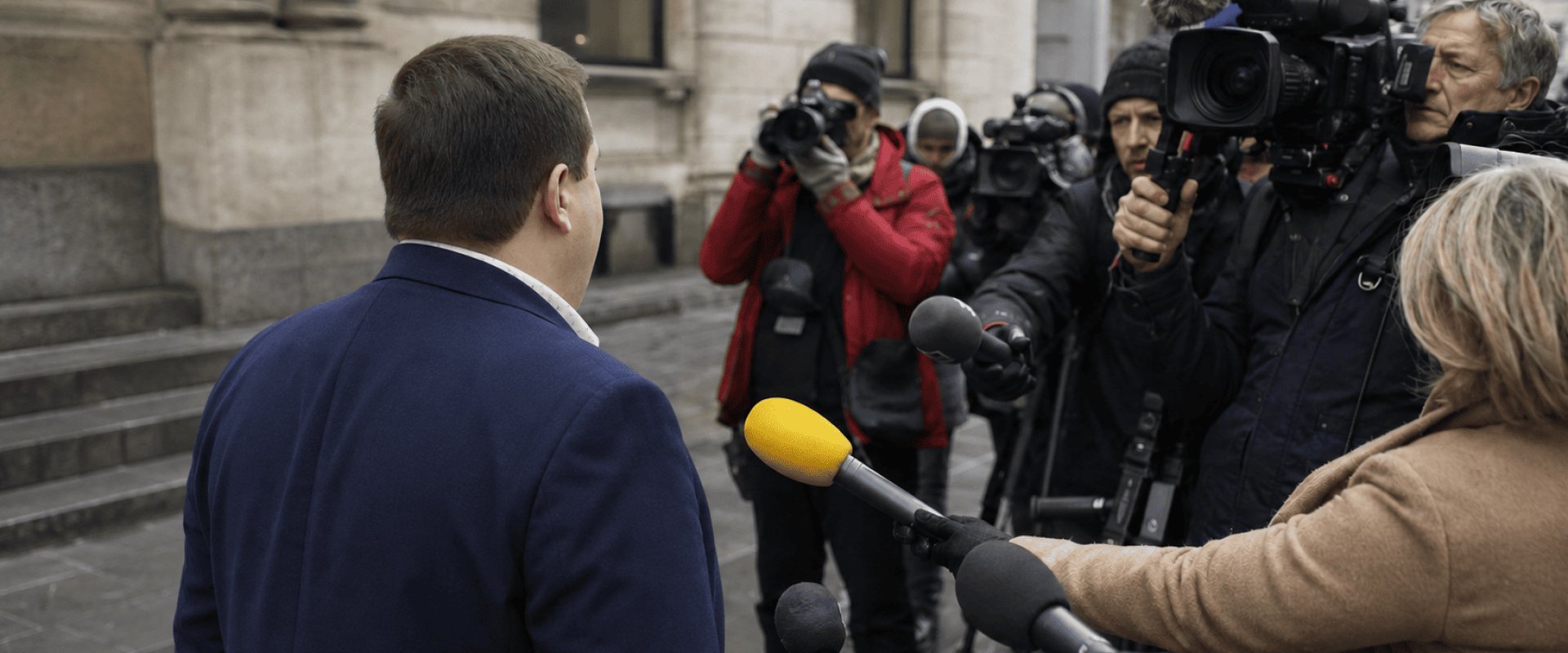
Media: Stop the license to lie !
Revolution wants to end the de facto criminal immunity enjoyed by the media and finally hold journalists accountable before the ordinary courts.
In Belgium, a citizen who publicly damages a person's reputation may be called upon to answer for their actions. However, when a false accusation, seriously distorted information or a smear campaign takes the form of a press offence, the Belgian Constitution requires, in principle, that the case be brought before the Court of Assizes and that a popular jury be convened. In practice, the procedure is so cumbersome, costly and exceptional that criminal prosecutions have become almost non-existent.
The result has a name: de facto criminal immunity!
Journalists are admittedly not legally untouchable. A victim may attempt to bring a civil action, demand a right of reply or refer the matter to a professional ethics body. But who can seriously claim that these mechanisms repair the harm caused by a lie published on the front page of a major newspaper, repeated on television, relayed on the Internet and then shared thousands of times? The denial often comes too late, when it comes at all... which is never guaranteed. The reputation, meanwhile, has already been destroyed, and that is irreparable!
A fundamental freedom transformed into a privilege
Révolution defends freedom of the press. We reject censorship, thought policing and any intervention by political authorities aimed at dictating to newsrooms what they should write. But freedom of the press is not a licence to lie, defame, manipulate or condemn someone in the eyes of public opinion before a court has even delivered its ruling.
Freedom without responsibility does not remain freedom for long: it becomes a privilege. And when such a privilege belongs to those who control the microphones, cameras, studios and front pages, it becomes a formidable weapon against those who have no equivalent means of defending themselves.
The problem is not a mistake made in good faith and then acknowledged and properly corrected. Every human being can make mistakes. The problem begins when a newsroom publishes without checking, selects the facts that support its narrative, confuses information with activism, presents a hypothesis as a certainty, refuses to engage with serious contradictory evidence or buries a correction in an invisible corner after displaying the accusation on its front page.
Too often, some media outlets no longer content themselves with reporting the facts: they choose the good guys and the bad guys, stage the public trial, manufacture suspicion and impose their verdict. They no longer seek to inform citizens, but to steer their thinking. They are then no longer a countervailing power: they become instruments of propaganda.
Media lies are never harmless
The power of a media outlet gives each of its claims considerable reach. Many citizens still believe that whatever is announced on the television news or printed in a national daily newspaper has necessarily been verified. This trust gives journalists immense power: the power to make or break a reputation, influence an investigation, weigh on a trial, isolate a person and sometimes ruin their family or professional life.
In the face of such power, the right of reply is not enough. A late response does not erase a viral accusation. A few discreet lines do not make up for devastating coverage. A decision by a professional ethics body, however well-founded, does not always provide redress commensurate with the damage.
And while the victim has to pay money up front, gather evidence, endure years of proceedings and publicly relive their humiliation, the media outlet carries on with its activities as though nothing had happened. This imbalance is no longer acceptable.
Article 150 establishes de facto criminal impunity
Article 25 of the Constitution rightly proclaims that the press is free and prohibits censorship. Article 150 nevertheless provides that press offences fall within the jurisdiction of a popular jury, with the exception of those inspired by racism or xenophobia. This historic safeguard was intended to protect the press against arbitrary state power. Today, however, because of the cumbersome nature of proceedings before the Court of Assizes, it makes criminal prosecutions extraordinarily rare.
This reality is not an invention of Révolution. Belgian parliamentary documents themselves refer to “de facto criminal immunity” and “de facto decriminalisation”. In other words, our system acknowledges the problem but continues to allow it to thrive.
This system is all the more inconsistent because a publication inspired by racism or xenophobia can already be tried by the criminal court. The principle of an exception to the jurisdiction of the Court of Assizes therefore already exists. This is not about inventing an unimaginable rupture, but about putting an end to an anomaly that has become indefensible.
What Révolution proposes !
Révolution is calling for a clear constitutional and legislative reform in order to:
- entrust press offences to the criminal court, so that they can genuinely be prosecuted and tried;
- strictly distinguish facts from opinions: criticism, however harsh, must remain free, but a false factual claim that causes serious harm to another person must be subject to sanctions;
- target serious conduct, including knowingly disseminated lies, deliberate manipulation, defamation and publication marred by gross negligence in verification;
- impose a swift, visible and proportionate right of reply, published with exposure comparable to that of the disputed information whenever a correction is required;
- provide for proportionate sanctions and effective redress for the harm caused, without allowing political authorities to control editorial content;
- protect good-faith journalism, serious investigations, whistleblowers and the disclosure of information in the public interest.
Neither censorship nor a tribunal of truth
Our opponents will certainly try to portray this reform as an attack on freedom of the press. That is false. Révolution does not want to create a Ministry of Truth or give the government the power to choose which information is authorised. We want disputes to be decided by independent judges, with respect for the rights of the defence, the presumption of innocence and the European right to freedom of expression.
Criticism of those in power, institutions, companies and public figures must remain broad, vigorous and unsettling. But no journalist should be able to invoke freedom of the press to fabricate facts or knowingly smear someone. Democracy needs a free press; it needs a responsible press just as much.
Journalists rightly demand transparency from political leaders. They hold citizens, companies, police officers, judges and elected representatives to account. They must accept the same requirement for themselves. One cannot claim the role of the fourth estate while refusing the responsibilities that come with all power.
Making the press worthy of the people's trust
Distrust of the media does not come from nowhere. It grows every time an obvious error is not acknowledged, a right of reply is refused, a misleading headline takes the place of the facts or a newsroom protects its narrative instead of seeking the truth. Those who reject all questioning do not defend the press: they accelerate its loss of credibility.
Révolution wants to restore a simple principle: the more power one has over public opinion, the more one must answer for how that power is used. Freedom of the press is indispensable to democracy. Its impunity is not.
We will therefore put an end to this judicial privilege from another age. We will give the criminal court the jurisdiction required to effectively try press offences, with strict safeguards against abusive prosecutions. We will strengthen the right of reply and the visibility of corrections. We will protect honest journalism, but we will no longer protect lies on the pretext that they are printed, filmed or broadcast by a media outlet.
In a democracy worthy of the name, no one is above the law. Not even those who claim to speak in the name of truth!