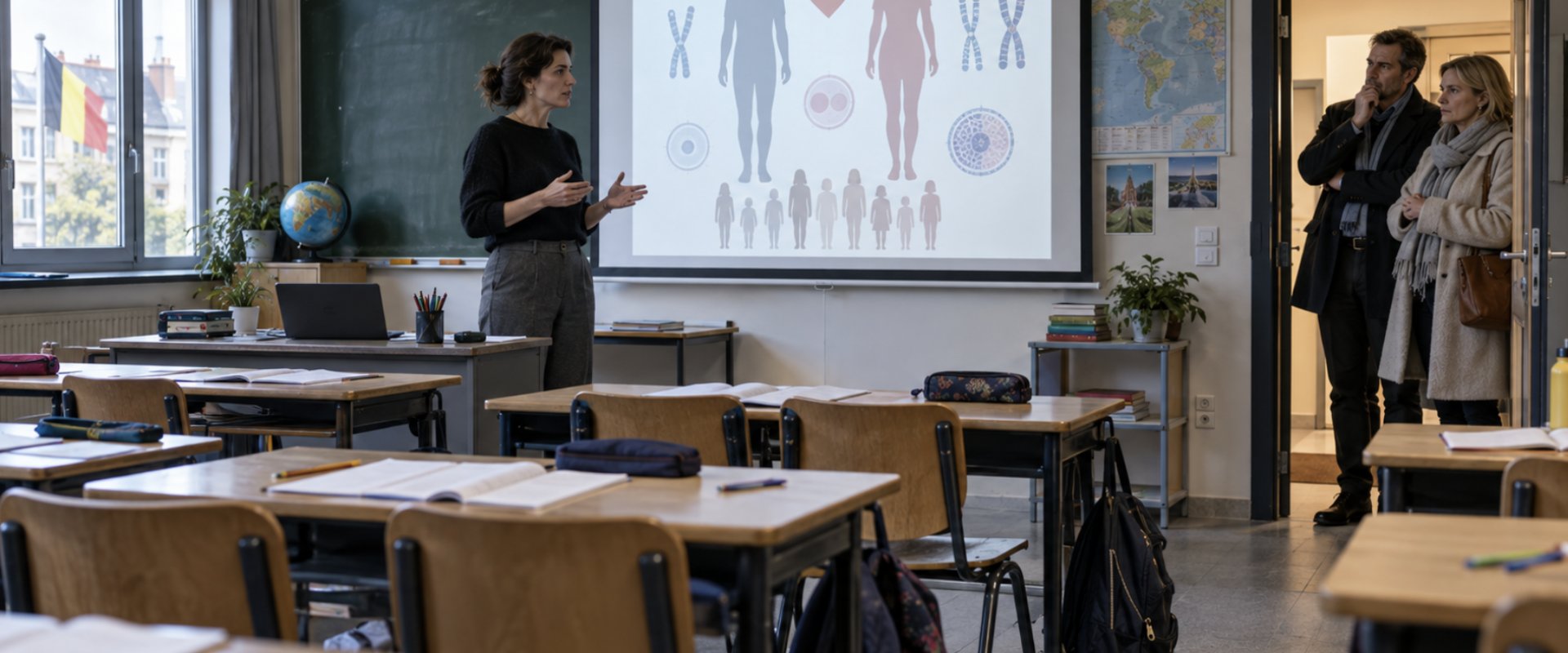
EVRAS: School should educate our children, not train them in sex !
Revolution demands the removal of sex education classes from schools and their replacement with genuine education in respect, protection, and responsibility!
Under a reassuring acronym – EVRAS, for “Education for Relational, Emotional and Sexual Life” – the authorities claim to protect young people, prevent violence and answer their questions. Who could be against respect, prevention of abuse or protection of children? Person !
But behind these noble objectives lies an official Guide of more than 300 pages which opens the door to content that many parents consider intrusive, premature and profoundly unsuitable for the psychological development of the child.
Revolution refuses to use child protection as a Trojan horse to impose explicit discussions on sexuality, pornography, sexual practices or gender identity on minors. School does not have to become the place where an adult takes the initiative to introduce into the psyche of a child images, words and questions that he never asked for.
Our position is clear: sex education classes should be removed from schools. They must be replaced by relational education centered on respect for the body, limits, integrity, prevention of violence, empathy and the right to ask for help. Essential medical information must remain factual, age-appropriate and provided within a strict, transparent framework that respects parental authority.
What we don’t tell parents clearly
Since 2023, schools in the Wallonia-Brussels Federation must organize at least two periods of EVRAS activities in primary 6 and two periods in secondary 4. These obligatory activities must be given by certified structures. But EVRAS is not limited to these four periods nor to these 2 levels: it is included in the school's missions and associated content can be addressed transversally during the school career from kindergarten onwards!
The Official Guide intended for professionals covers children and young people from 5 to 18 years old. It does not constitute a program mechanically imposing each theme on each class, but it constitutes a reference capable of guiding practices. This is precisely where the danger lies: very broad guidelines leave considerable room for interpretation for the adult facing the children.
The Wallonia-Brussels Federation itself confirms that EVRAS can relate to “sexualities and sexual behaviors”, pleasure, pornography, sexual orientation and gender identity. It also specifies that components of EVRAS can be addressed throughout the common core, from 3rd kindergarten to 3rd secondary school. (Official source of the Wallonia-Brussels Federation)
So let's stop pretending that the concerns are completely invented. The passages exist. The testimonies exist. The minutes exist. The question is not to give in to rumor, but to know why a system which claims to protect the child agrees to take such risks with their privacy?
From 5 years old: touch, bodily pleasure and “erogenous zones”
In the section intended for 5-8 year olds, the Guide addresses pleasure and bodily sensations. Should we encourage 5-year-old children to discover sexual pleasure? Is this a mission of the school? We don't think so!
Among the knowledge proposed are the pleasure linked to touch and the discovery of sensitive parts of the body. The analysis document sent by the ASBL Droits de l’Enfance notes in particular the wording relating to “erogenous zones” and the fact that the Guide mentions early self-stimulation. Basically, school will encourage your children to masturbate from the age of 5! Why want to confront such young children with sexuality? Isn't this a way of trivializing sexuality, or even encouraging pedophilia?
We will be told that talking about the body helps prevent abuse. But teaching a child that their body belongs to them, that no adult can touch their private parts, that they have the right to say no and that they must talk to a trusted person does not require encouraging them to enjoy sexual pleasure or conceptualizing their sensations.
At five or six years old, a child is not a miniature adult. He has neither the emotional maturity nor the ability to distance himself from an adolescent. Introducing unsolicited sexual vocabulary at school can cause embarrassment, confusion or anxiety. Child psychiatrist Maurice Berger talks about break-in of the psyche when a child is confronted with words or images beyond his capacity to integrate them. He reports in particular refusals to return to school, sleep problems, nightmares, astonishment and lasting disgust after certain sex education sessions. (Analysis by Dr. Maurice Berger)
Protecting a child does not mean anticipating their sexuality. It’s respecting your rhythm!
From 9 years old: pornography presented with its “positive and negative” aspects
Another astonishing passage: for the 9-11 year old age group, the Guide plans to work on the positive and negative influence of pornography. Further, he invites young people to develop a critical outlook on this content. Instead of encouraging our children to read books by great authors, we encourage them to watch porn so that they have a critical look at sex films! Yet another way of trivializing sexuality among our children! And then, we will be surprised to see 12 year old children engaging in gang rape in the toilets of our schools! Those who voted for these “courses” are guilty of these actions!
Of course, children can be accidentally exposed to pornographic images online. This reality requires firm prevention: explaining to them that these images are not made for them, that they can be violent, false and dangerous, and that they must immediately speak to a trusted adult.
But why present pornography from the angle of possible “positive” influences to 9 year old children? What could be the positive aspect of porn films on our children? Why should the school introduce this subject to an entire class, including children who have never been confronted with it? Preventing a danger does not require standardizing it or detailing the codes.
The same goes for intimate photos. Teaching a child that they should never send a photo of their body, that they should never give in to pressure and that they should alert an adult is legitimate. Explaining to him how to manage sending “nudes” as if it were a predictable part of his social life crosses a red line and even constitutes, in our opinion, an incitement to debauchery!
At age 12: “fun” sexuality and transactional sex
For 12-14 year olds, certain guidelines go even further. The Guide mentions the ability to explain how to make sex enjoyable or fun. “Come on, during recess, have fun children and sleep with each other!”
The Guide also addresses consent in so-called transactional sexual relationships, that is to say in exchange for gifts, meals or outings. While we're at it, let's train our children in prostitution! “Come on, you give me a blowjob and in return, I’ll do your duty.” The school of 2026 is beautiful!
At this age, the school's priority should be clear: protecting young people from pressure, exploitation, pornography, image blackmail and predatory adults. The message must not suffer from any ambiguity. The body of a minor is not a currency. A relationship obtained against a gift or under pressure should not be trivialized in the form of a discussion exercise on consent.
When institutional language becomes so abstract that it ends up treating the unacceptable as a simple “situation” to be analyzed, it no longer protects: it disarms. This trivialization of deviant behavior is unbearable!
Testimonies that should cause a political scandal!
The risks are not just theoretical. The Children's Rights non-profit association publishes several testimonies and extracts from minutes following activities. These elements must be presented for what they are: testimonies collected by the association and, for some, disputed facts or the subject of a procedure. They do not yet all constitute final judicial decisions. But their precision and seriousness demand investigation, not contempt.
Now you have to read the children's words. Not government slogans. Not the communication brochures. Children's words.
At nine years old, she comes home panicked at the idea of “becoming a transsexual”
In a testimony relating to three activities organized during the 2022-2023 school year in an official school in Walloon Brabant, a mother says that her nine and a half year old daughter came back from a play panicked at the idea of “becoming transsexual”. According to the mother, the teacher then spoke about the rights of transgender people and their implications, including surgical ones.
When his mother offers to talk to the teacher about it, the child refuses. She fears that the school will view her family as “intolerant.”
This is a particularly worrying mechanism: a child is upset, but she no longer dares to confide in school because she has already been taught that any parental objection could be assimilated to intolerance. It's no longer education. It is a moral or even political pressure that places the child between his family and the institution. However, school is not there to play politics, to say who are the good political parties or the bad political parties, what are the good ideas and what are the bad. There, by acting in this way, the school becomes an organ of political propaganda and that is unacceptable!
The same family reports that during an activity on puberty, an eleven and a half year old student who identified as a boy was allegedly invited, in front of the whole class, to choose whether she wanted to join the group of girls or that of boys. Such an intimate and complex question was thus exposed publicly to the comrades. Where is the protection of this child's privacy? Where is the individualized support? Where is the caution?
At eleven years old, we explain to them how to send intimate photos without being recognized
The same mother reports that an officially announced animation on cyberbullying drifted towards sending “sexts” and “nudes”, without this theme having been announced to parents.
According to his testimony, the solution given to the students would not have been: “Never send intimate photos. » as common sense would have dictated. Except that the host would have advised the children, if they still decided to send some to their lover, to take a photo of themselves from the feet to the neck so that the face is not identifiable, in front of a white or beige background to prevent them from recognizing their room. Are we at school or in Onlyfans training?
Do we understand the seriousness of such advice? It would amount to teaching children how to more discreetly produce sexual images of themselves. However, a sexual photograph of a minor can be copied, distributed, used to blackmail them and fall into the hands of predators. A child should not learn how to make an “anonymous nude”. It must mean a protective, simple and absolute prohibition: never send an intimate image of your body!
At ten years old, he asks for the course to be erased from his memory
Another mother reports an event organized in 4th primary school in January 2024, without her giving her consent. Her ten-year-old son reportedly said he was disgusted and asked her twice to “erase this from his memory.”
According to the story, the children had to draw a uterus with the clitoris, talk about the menstrual products their mothers used, fill out a sheet indicating how they felt "in their cycle" and look at pictures of blood-stained panties. The boy reportedly told his mother: “I was very uncomfortable, I think it’s intimate and it’s not for children. »
The words of this child are more sensible than all the institutional propaganda: it’s intimate and it’s not for children!
An erect penis in front of first secondary students!
According to testimonies from parents and a report cited by Droits de l’Enfance, a teacher used an object representing an erect penis in front of several first-secondary classes in order to place a condom on it. Comments would have focused on fellatio, masturbation, means of orgasm and the taste of flavored condoms. The speaker will go so far as to say that there are Cola flavored condoms! Well yes, children, don't worry, you will love the taste!The Children's Rights association indicates that legal proceedings are underway regarding this matter. (Petition and presentation of the file)
Is this what protecting twelve year old children is? Is it the role of the school to organize a collective sexual demonstration in front of minors who have neither asked to attend nor the real possibility of leaving the room without exposing themselves to the gaze of the group? What's next? Practical sexuality education classes?
Condoms and lubricants distributed to young students
A report from an organizing authority of a secondary school in the province of Namur, reproduced by the association, also mentions the free provision of condoms and lubricants during lunchtime. The document reports that young students jumped on it and used it for fun.
This result was predictable. When the institution introduces sexual objects into a group of very young adolescents without measuring their maturity, it does not automatically create responsibility. It can create excitement, social pressure, mockery and confusion.
At 11 or 12 years old: “you have to try” masturbation
In another testimony concerning a 6th primary class in Walloon Brabant, the students apparently watched a cartoon explicitly explaining masturbation. According to the parents cited, the facilitator then repeated that this practice was natural and that it should be tried!
The difference is fundamental between responding tactfully to a young person's individual question and suggesting an intimate practice to an entire class. An adult commissioned by the school does not have to prescribe, encourage or verbally experiment with children's privacy.
Children who come home with intrusive questions
After activities organized behind closed doors in 4th and 5th grade primary classes in a Brussels school, children's comments were recorded by a group of parents. What they say should chill every father and mother:
- Nine-year-old girl: “I found it disgusting. »
- Another: “I was disgusted by how to make babies. »
- A ten-year-old boy asks his mother what his “grade of erection” would be and if he has ever had “cardboard underpants”.
- An eleven-year-old boy explains that the facilitator asked him to define an erection in front of the girls.
- An eleven-year-old girl reports that students were separated into those who “feel like girls” and those who “feel like boys.”
- A ten-year-old boy says that the workers insisted on knowing if he had ever had a lover and concluded: “I don’t want to go back there again. »
- A 6th grade student allegedly asked her mother if she masturbated and in which direction her father's penis was placed when he had an erection.
This is the concrete result of certain sessions: the school is no longer content with transmitting a rule of protection. It forces adult sexuality into the child’s family imagination. (Testimonies collected by Droits de l’Enfance)
At nine years old, a demonstration of penetration by gestures
The book transmitted by Droits de l’Enfance also includes two French testimonies, from the work of SOS Education. They therefore do not directly concern the Belgian system, but show what collective sexual education can become when the limits disappear.
In a first case, students aged nine to ten would have received detailed definitions of ejaculation and sperm. A child would have started to cry; many were reportedly shocked, disgusted or embarrassed and refused to return to class.
In a second testimony, a mother claims that a worker explained to nine-year-old children how the penis enters the vagina, by miming back and forth movements. She then allegedly talked about using condoms. The parents would not have been informed in advance. When the mother protested, the director allegedly accused her son of lying and threatened the mother with defamation proceedings and reporting.
This French case should serve as a warning to Belgium: when a system considers that the school no longer needs to warn parents, institutional authority can be used not only to impose crude content on children, but also to intimidate protesting families.
A teenage victim of incest plunged back into her trauma
The most moving testimony concerns a teenage victim of incest, received in a child psychiatric center. During an event bringing together young people of different ages, participants were questioned about their experiences, preferences and sexual practices. The young girl would have been stunned and plunged back into the images of the violence suffered, without being able to leave the room. According to the story, nearly two-thirds of the group eventually walked out when another youth dared to leave.
Even in a place supposed to heal, collective sexual speech can become a new violence when it is imposed without taking into account the trauma, modesty and rhythm of each person.
The consent of children is invoked everywhere, except when the course is imposed on them
The paradox is immense. We explain to young people that consent must be free, informed and revocable. But did they consent to hearing this content? Can they refuse a question? Can they go out without having to justify themselves? Do parents receive in advance the exact content, materials, images, objects used and questions that will be asked?
Simple general information is not enough. When it comes to the psychological and sexual intimacy of a child, families must have a real right of inspection and refusal.
The secrecy sometimes surrounding the precise content of the animations is incompatible with trust. Any support intended for a minor should be able to be consulted beforehand by their parents. Any intervention should be recorded or the subject of an accessible report. Any complaints should trigger an independent investigation. No operator should be able to hide behind an administrative label.
Where is the independent scientific validation of the Guide?
The promoters of EVRAS repeat that the Guide would have been co-constructed by institutions, professionals and young people. But co-construction between actors already engaged in the sector is not independent scientific expertise. A consultation is not clinical validation. An accumulation of opinions does not constitute a report demonstrating the psychological safety of the content offered at each age.
UFAPEC, the representative organization of parents in Catholic education, writes that no validation procedure for the Guide has been put in place and that final responsibility fell to the non-profit organization O’YES and the Secular Federation of Family Planning Centers. (Historical analysis of UFAPEC)
This information is explosive. How could a document affecting the privacy, emotional development and psyche of hundreds of thousands of minors become an official tool without clearly identifiable independent scientific validation? Where is the formal opinion of a pluralist college of child psychiatrists, developmental psychologists, pediatricians, trauma specialists and child protection lawyers? Where is the study assessing the risk of psychological breakdown? Where is the demonstration that the content offered respects the latency period and the differences in maturity within the same class?
Caroline Désir, then socialist minister of Education, politically supported the generalization of EVRAS. Valérie Glatigny, then liberal Minister of Youth and Youth Assistance, also signed the agreement, alongside other members of the executives concerned. These managers cannot hide behind operators or behind the magic word “experts”.
Revolution publicly calls on them to be held accountable and to publish:
- the complete nominative list of scientific experts who validated the final version of the Guide;
- their exact qualifications, mandates and possible conflicts of interest;
- all written opinions, both favorable and critical;
- the minutes of the validation meetings;
- the scientific methodology used;
- studies on the psychological effects of this content according to age;
- any “expert report” invoked before a government, a commission or a parliament.
And if no independent validation report exists, let them have the courage to admit it. In this case, political power will have imposed a framework affecting the privacy of children without being able to produce the scientific guarantee for which it implicitly claims. This would be a major political mistake!
At this stage, we will not present as an established fact the assertion that a minister cited a fictitious report: we are specifically asking that all documents be made public. But the reversal of the burden of proof is complete. It is not up to parents to demonstrate that the Guide could be harmful. It is up to those who have adopted it to prove, with supporting documents, that they have carried out the essential checks before exposing the children.
What Revolution offers
Revolution asks:
- The elimination of sex education lessons and activities at school, whether mandatory or transversally integrated;
- The withdrawal of the current EVRAS Guide as professional reference;
- The replacement of EVRAS with relational and protective education, focused on respect, empathy, physical integrity, boundaries, modesty, harassment prevention and the ability to ask for help;
- Clear prevention of sexual abuse, with simple age-appropriate messages: your body belongs to you, no one can force intimate contact on you, a threatening secret must be revealed to a trusted adult;
- Strictly factual biological and health information, linked to puberty, reproduction and infections, provided at an appropriate age (that of sexual majority of 16 years for example) and without encouragement to practices;
- Total transparency towards parents, with prior consultation of all contents and media;
- An effective right of exemption, without pressure or stigmatization of the child or his family;
- An independent parliamentary commission of inquiry on the abuses reported, the operators concerned, the labeling mechanisms and the follow-up of complaints.
Childhood is not a field for ideological experimentation!
We will probably try to silence this debate by accusing opponents of being retrograde, conspiratorial or hostile to people who are different. This is a lazy method. Defending a child’s modesty is not denying the existence of LGBT adults. Refusing LGTB propaganda at school does not mean refusing the existence of trans, lesbian or other people... Refusing pornography at nine years old is not refusing prevention. Challenging an intrusive animation is not covering up sexual violence.
On the contrary: it is because abuse exists that simple, powerful and appropriate protection messages are needed. It is because children are vulnerable that adults must measure each of their words. It is because the school exercises immense authority that it must impose strict limits on itself.
The State does not own the privacy of children. A label does not give all the rights. An administrative guide will never replace the knowledge that a parent has of the maturity, history and sensitivity of their child. At Revolution, we believe that our children do not belong to the State but to their parents!
School must teach our children to read, write, count and think. School must impart knowledge to our children. It is a mission that schools are already failing to fulfil, since the results of the PISA 2025 survey once again reveal the very mediocre performance of French-speaking Belgian education compared with other developed countries. Worse still, since 2018, results have fallen by 28 points in mathematics, 15 points in reading and 3 points in science. We therefore offer our schools this advice: if they are incapable of properly educating our children, they should not waste their time introducing them to sexuality!
For Révolution, the red line has been crossed. We demand the withdrawal of the EVRAS Guide, an end to sex education classes at school, and the opening of a public debate in which parents will no longer be treated as an obstacle, but recognised as those primarily responsible for their children.
Our children are not guinea pigs. Their innocence, their modesty and their pace of development cannot be negotiated!
To go further
- Official guide for EVRAS - guidelines and learning
- Official framework of EVRAS in the Wallonia-Brussels Federation
- Analysis by child psychiatrist Maurice Berger
- Testimonies collected by Droits de l’Enfance
- Petition for child-friendly EVRAS
Strictness note: the passages in the Guide are guidelines intended for professionals and do not mean that all themes are taught systematically in all classes. The concrete cases cited come from testimonies and minutes published by the ASBL Droits de l’Enfance; some are the subject of ongoing legal proceedings and should not be presented as having already been definitively judged.