Lightweight housing, autonomy and dignity: what if we finally rethought our way of living?
In Belgium, thousands of citizens work, pay their taxes, respect the rules, and participate in society. Yet, every year, more and more of them discover a worrying reality: finding decent housing is becoming increasingly difficult.
For some, buying a home has become inaccessible. For others, rent takes up an ever-increasing share of their income. For others still, waiting for social housing can take years.
Behind the numbers, there are faces. Young people postponing their life plans. Single-parent families counting every euro. Workers who, despite having a job, struggle to make ends meet. Retirees living with the constant anxiety of an unexpected bill. And people who sometimes fall into precariousness or homelessness.
Faced with this reality, one question deserves to be asked: is the problem only a lack of housing, or have we locked housing into a model that has become too narrow to meet today’s realities?
A single model that no longer reflects all realities
For decades, the path has seemed mapped out in advance: study, find a job, take out a loan, buy a house, then work for several decades to pay it off.
This model has allowed many people to build their lives, but it no longer corresponds to everyone’s reality. Above all, it should not be the only possible path.
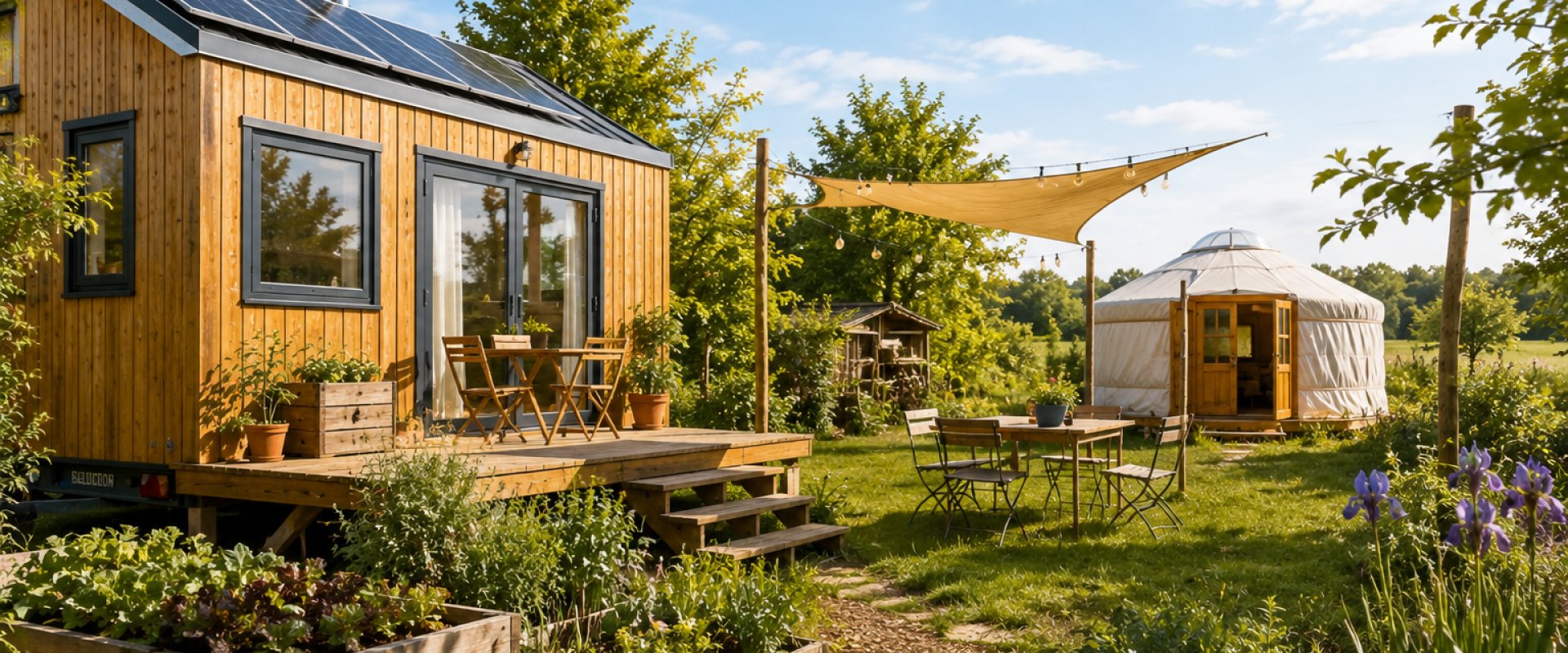
Because all across Belgium, citizens are already imagining other solutions: tiny houses, yurts, geodesic domes, zomes, shipping containers converted into homes, grouped housing, ecovillages…
Places to live where certain resources are shared while preserving privacy.
These initiatives are not whims or passing trends. They are often the result of deep reflection.
How can we reduce the cost of housing? How can we reduce energy dependence? How can we regain time instead of devoting an entire life to repaying debts? How can we live in a simpler, more resilient way, more in line with our values?
For many, light housing is not a renunciation. It is a search for freedom.
When autonomy runs into administrative obstacles
Yet when a citizen wishes to take this path, they often encounter a complex reality: administrative procedures, sometimes contradictory regulations, the absence of a clear framework, and differing interpretations from one municipality to another.
As if our society had difficulty recognizing what lies outside already established paths.
And yet, the paradox is striking.
We talk about ecology.
We talk about sobriety.
We talk about resilience.
We talk about autonomy.
But when citizens try to put these principles into practice concretely, they discover a path strewn with obstacles.
It is a bit like explaining every day to a bird the importance of flying while keeping the door of its cage closed.
Behind every file, there is a person
This reflection goes far beyond the issue of housing. It touches on something more fundamental: what place do we want to give human beings in our society?
Because behind every administrative file, there is a person. A story. A family. Sometimes difficulties. But also skills, ideas and a capacity for innovation that our institutions often underestimate.
The Mouvement Révolution carries precisely this reflection. Not by opposing citizens to institutions. Not by seeking confrontation. But by proposing a change of perspective.
What if we trusted citizens more?
What if the role of public authorities consisted above all in guaranteeing safety, health standards and respect for the environment, while allowing greater freedom in life choices?
After all, why should a person who wishes to live in an autonomous tiny house, produce part of their own energy, collect rainwater and grow their vegetable garden face more obstacles than a conventional real estate project financed over several decades?
This question is not ideological. It is deeply human.
Autonomy as a response to the crisis
Behind light housing lies a broader issue: autonomy.
Energy autonomy.
Food autonomy.
Financial autonomy.
Decision-making autonomy.
Not in order to live cut off from the world, but to regain a capacity for action in a world where many people feel they no longer control much.
Autonomy does not mean withdrawal. It means responsibility. It means resilience. It means the ability to get through crises with greater stability and confidence.
Other countries are already exploring these paths
Other countries have already begun to move in this direction.
In the Netherlands, neighbourhoods dedicated to tiny houses are emerging. In Denmark, ecovillages and cooperative housing enjoy genuine recognition. In Portugal, some regions actively support rural revitalization projects and alternative ways of life. In Finland, housing policy is based on a simple but powerful principle: first provide people with a stable roof before solving other difficulties.
These experiences are not perfect, but they show that it is possible to innovate. That it is possible to experiment. That it is possible to adapt rules to human realities rather than systematically demanding the opposite.
Allowing everyone to freely choose their way of living
In the spirit of the Mouvement Révolution, the question is therefore not whether everyone should live in a tiny house or a yurt.
The question is to allow everyone to freely choose their way of living when it respects criteria of safety, health and the common good.
This vision could pave the way for:
-
clear and coherent recognition of light housing throughout Belgium;
-
simplified procedures for autonomous projects;
-
the opening of public land or unused wasteland to citizen projects;
-
the creation of experimental ecological villages;
-
the development of housing cooperatives;
-
support for local energy communities;
-
new responses to homelessness based on rapid access to decent housing.
Rethinking the wealth of a nation
The true wealth of a nation is not measured solely by its economic growth.
It is measured by its ability to allow everyone to live with dignity. By its ability to encourage initiative rather than hinder it. By its ability to trust the collective intelligence of its citizens.
Today, the question may no longer be:
« Should more tiny houses be authorized? »
The real question is:
« Are we ready to imagine a society where several paths can lead to a dignified, free and responsible life? »
Light housing may not be the solution to all problems, but it invites us to ask an essential question. A question that goes beyond walls, permits and regulations. A question that touches the very heart of our democracy:
Do we trust citizens enough to allow them to take part themselves in building the world in which they wish to live?
Because change does not always begin in institutions.
It often begins when a human being dares to imagine that another path is possible.
And perhaps the deepest revolution begins precisely there...