Permaculture to empower citizens in food matters !
Revolution offers a model for feeding the Earth and humankind, strengthening self-sufficiency, protecting life, and empowering citizens in food matters. Let's not wait for the government to do everything; let's take action !
Faced with the rising cost of living, soil degradation, and the loss of biodiversity, permaculture now appears as much more than a simple gardening method: it is a global, ecological, and social response to the challenges of our time.
It invites us to deeply rethink our relationship with the Earth, considered not as a resource to exploit, but as a living, nurturing entity that must be respected and protected.
Returning to essentials: Mother Earth as a nurturing force
Permaculture is based on a fundamental vision: the Earth is a living organism. Soils, plants, animals, and humans form an interdependent whole. Respecting this natural harmony means ensuring our own survival.
Taking care of the Earth means preserving its fertility, protecting its natural cycles, and rejecting destructive practices such as the intensive use of chemicals or the excessive exploitation of resources.
Cultivating differently, even on small surfaces
Contrary to popular belief, it is not necessary to own large plots of land to practice permaculture. Balconies, small gardens, courtyards, or even windowsills can become productive spaces.
Thanks to techniques such as:
- container or lasagna gardening
- companion planting
- vertical growing (trellises, green walls, …)
It is possible to produce a surprising amount of food on very small surfaces. In a context of rising inflation, these practices significantly reduce food expenses while increasing autonomy.
Shared gardens and the use of unused land
Cities are full of unused spaces: vacant lots, urban wastelands, abandoned plots. These places could be transformed into collective gardens accessible to all.
Making these lands freely available to citizens would:
- strengthen social bonds
- produce local and healthy food
- bring neglected areas back to life
Shared gardens are also places of learning, knowledge transmission, and solidarity, where everyone can contribute according to their abilities.
Supporting individuals towards autonomy
Not everyone has the knowledge or physical ability to create a vegetable garden. It is therefore essential to develop support initiatives:
- assistance with setting up home gardens
- training for beginners
- support for elderly or vulnerable people
- implementation of permaculture education in schools from an early age
These actions promote inclusion and allow everyone to access a form of food autonomy, even partial.
The importance of medicinal plants
Permaculture also restores a central place to medicinal plants. Growing these plants means rediscovering ancestral knowledge and a certain independence from conventional healthcare systems as well as from Big Pharma, thirsty for money, power, and CONTROL over our lives.
Thyme, chamomile, mint, sage, calendula, and many others can easily be integrated into a garden, offering natural therapeutic properties, reduced medical expenses, and reconnection with traditional knowledge.
Protecting pollinators and developing beekeeping
Bees and other pollinators play a crucial role in food production. Yet they are now severely threatened.
Permaculture encourages:
- planting nectar-rich flowers
- reducing or even eliminating pesticides
- developing local beekeeping
Encouraging the presence of bees ensures pollination and therefore crop fertility.
Working with nature, not against it
One of the key principles of permaculture is to collaborate with ecosystems rather than trying to control them.
Thus, instead of eliminating pests with chemicals, priority is given to:
- introducing natural predators
- diversifying crops
- maintaining overall garden balance
This approach naturally limits pests while preserving biodiversity.
Saying no to pesticides and chemical inputs
Pesticides and chemical fertilizers degrade soils, pollute water, and harm human health.
Permaculture offers natural alternatives:
- plant-based preparations
- mulching
- crop rotation
- compost
These techniques sustainably enrich the soil and promote healthy production.
Water: a resource to protect and share
Water management is a major issue. Permaculture encourages the collection and intelligent use of rainwater.
Imagining widespread access to rainwater collection tanks, free of charge and untaxed would:
- reduce dependence on networks
- preserve natural resources
- make everyone responsible for their consumption
Free seeds and food sovereignty
The issue of seeds is central. Today, many varieties are controlled by large industries such as Bayer and Monsanto, limiting farmers' freedom.
Révolution advocates:
- natural and reproducible seeds
- the right to save one's own seeds
- plant biodiversity
Rejecting non-reproducible hybrid seeds and genetically modified organisms means preserving food independence and the richness of life.
The essential role of hedges
Often neglected, hedges are fundamental in an ecosystem:
- they protect against wind
- they shelter wildlife
- they enrich the soil
- they promote biodiversity
Replanting hedges means rebuilding living and resilient landscapes.
Integrating animals into agricultural systems
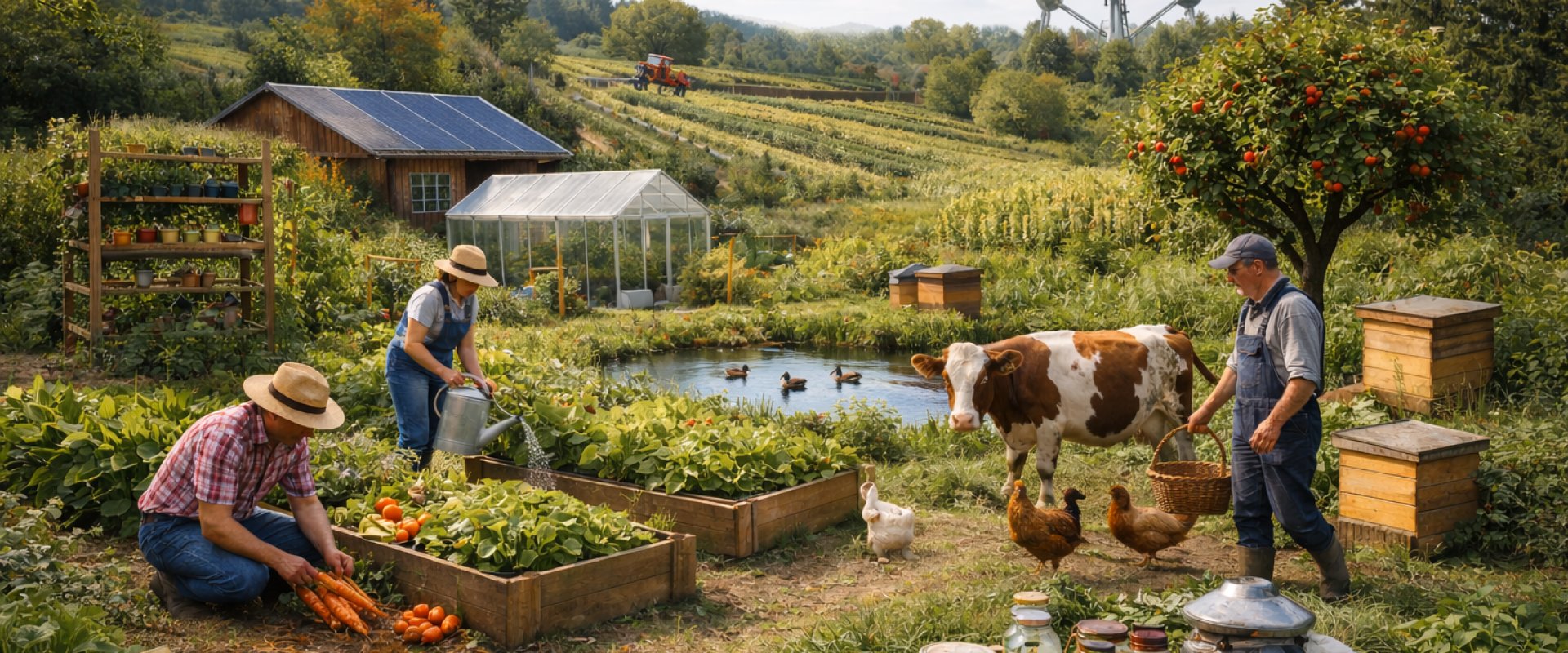
Animals have their place in permaculture. Chickens, sheep, horses, cattle, bees, and other pollinators, and especially earthworms, actively contribute to system balance.
They allow:
- natural soil fertilization
- regulation of certain pests
- valorization of organic waste
The goal of Révolution is to create beneficial interactions between all forms of life.
Agricultural transition: integrating professional farmers
The transition to permaculture and agroecology cannot happen without farmers. It is essential to support them concretely.
- Implementation of financial support for conversion to agroecological practices
- Gradual reduction of chemical inputs with technical support
- Creation of ongoing permaculture training programs for farmers
- Support for crop diversification and production relocalization
- Income guarantees during transition phases
Promoting short supply chains and local economy
To strengthen food sovereignty, it is necessary to relocalize food systems.
- Mandatory inclusion of a minimum percentage of local products in school canteens
- Priority to short supply chains in hospitals, schools, and administrations
- Support for local markets and agricultural cooperatives
- Development of local direct producer-to-consumer platforms
Electroculture: an alternative approach
Still little known, electroculture explores the influence of natural electromagnetic fields on plant growth.
Some practices involve:
- antennas
- metal structures
- devices capturing atmospheric energy
Although controversial, this approach is gaining interest and fits into the search for natural and non-invasive solutions. Révolution encourages all research and studies aimed at discovering new techniques or technologies to improve the lives of our fellow citizens by all possible and imaginable means.
Reforest and feed: rethinking our urban and rural landscapes
Reforestation is an essential lever for restoring ecological balance. Replanting forests regenerates soils, preserves biodiversity, and captures carbon.
But this approach can go even further by integrating fruit trees into our daily environments.
Planting fruit trees along streets, roads, public squares, or in villages would provide healthy, local, and free food, recreate a direct link between people and nature, promote local food autonomy, and green urban spaces.
These trees would also play a major climate role by creating shade, cooling cities, combating heat islands, and improving living comfort.
This type of initiative transforms landscapes into true food-producing ecosystems accessible to all, where everyone can harvest without depending on an industrial system.
Private gardens: an already existing agricultural revolution
What if the solution to a large part of our food, economic, and ecological crises was already… right under our windows?
In Belgium, the figures speak for themselves:
Approximately 80% of households have a garden. The average garden size is about 300 m².
At the national level, this represents nearly 2,400 km² of private land!
That is:
• almost the size of an entire province
• more than 160 times the size of a large city like Brussels
• equivalent to hundreds of thousands of football fields
And yet, this immense area remains largely underused, often reduced to decorative lawns with no food-producing value.
Agricultural potential without expropriation, concrete, or delay
If only 25% of these gardens were converted into permaculture vegetable gardens, it would still represent 600 km² of cultivable land.
That means:
- massive local food production capacity
- direct reduction of dependence on imports
- greater resilience to crises
And all of this:
- without soil artificialization
- without deforestation
- without massive investments
- without waiting decades
The solution is already here. It is accessible, immediate, and in the hands of citizens.
Giving power back to the people
Transforming these gardens into food-producing spaces is much more than an ecological issue. It is a strong political choice promoted by Révolution.
It means:
- giving citizens partial food autonomy
- reducing the impact of inflation on households
- creating social connections at the neighborhood level
- relieving pressure on industrial agricultural systems
It also means moving away from fragile supply chains toward a local, resilient, and human-centered model.
A political decision, not an impossibility
Nothing prevents encouraging this transition on a large scale today.
Simple measures could be enough:
- incentives to convert lawns into vegetable gardens
- subsidies for transforming lawns into food-producing spaces
- reduction of VAT on sustainable gardening equipment
- mandatory integration of vegetable gardens in new housing developments
- distribution of natural seeds
- installation support (tools, compost, rainwater collectors, …)
- free support for citizens
This is not a utopia. It is a matter of political will!
From useless lawns to food sovereignty
Every square meter of lawn could become:
• a source of food
• a refuge for pollinators
• a resilience tool in times of crisis
Taken together, these gardens are no longer isolated private spaces but the foundations of a true citizen agricultural network: a decentralized, living, and free agriculture.
A concrete response to economic and social challenges
In a context of inflation and economic uncertainty, permaculture offers accessible solutions:
- reduction of food expenses
- progressive autonomy
- creation of local mutual aid networks
- valorization of existing resources
Permaculture gives power back to citizens by making them actors of their own subsistence.
Conclusion: towards a more resilient society
Permaculture is not just an agricultural technique; it is a true societal project. It aims to rebuild a strong connection between humans and nature, based on respect, cooperation, and sustainability.
By valuing local resources, protecting living systems, and encouraging sharing, it opens the way to a fairer, more autonomous, and more harmonious future. These are all reasons and arguments promoted by the Révolution movement, insisting on reclaiming our sovereignty—whether food, medical, economic, social, or based on citizen solidarity from the youngest to the oldest. Every aspect of our lives belongs to us.
It is up to us to reclaim our rights and choose, with full awareness, for the future of coming generations!