End federalism and reunify Belgium!
End federalism and reunify Belgium! Federalism has brought nothing to Belgian citizens since its implementation. The only winners from federalism are the political parties, which have been able to multiply their ministerial positions. We propose a return to a unitary Belgium!
Since its establishment in 1993, federalism has brought nothing positive to Belgian citizens. Instead of resolving community disputes, federalism has built walls between Flanders and Wallonia. Belgians no longer know each other, Belgians almost no longer share anything, and exchanges between French speakers and Dutch speakers are becoming increasingly rare. In our schools, students prioritize English instead of learning our national languages. This reality only deepens the divide separating the two most important communities of our country. Our country resembles an old couple that prefers to ignore each other rather than argue. Unfortunately, when we ignore each other, indifference often gives way to separation. This is exactly what Révolution seeks to avoid by abolishing federalism - created by political parties to grant themselves ever more ministerial positions - in order to return to a unitary Belgium where everyone takes pleasure in understanding and discovering one another!
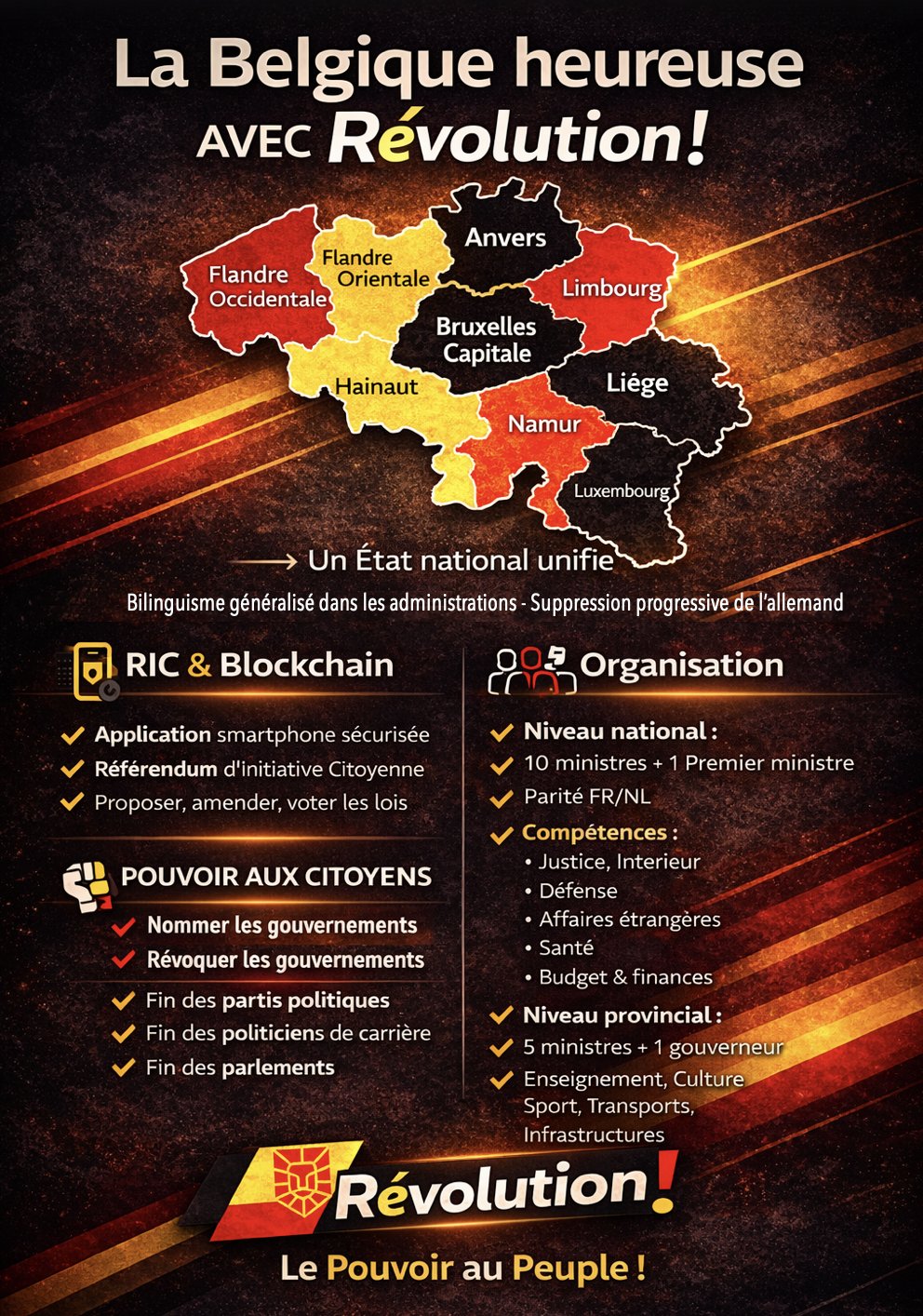
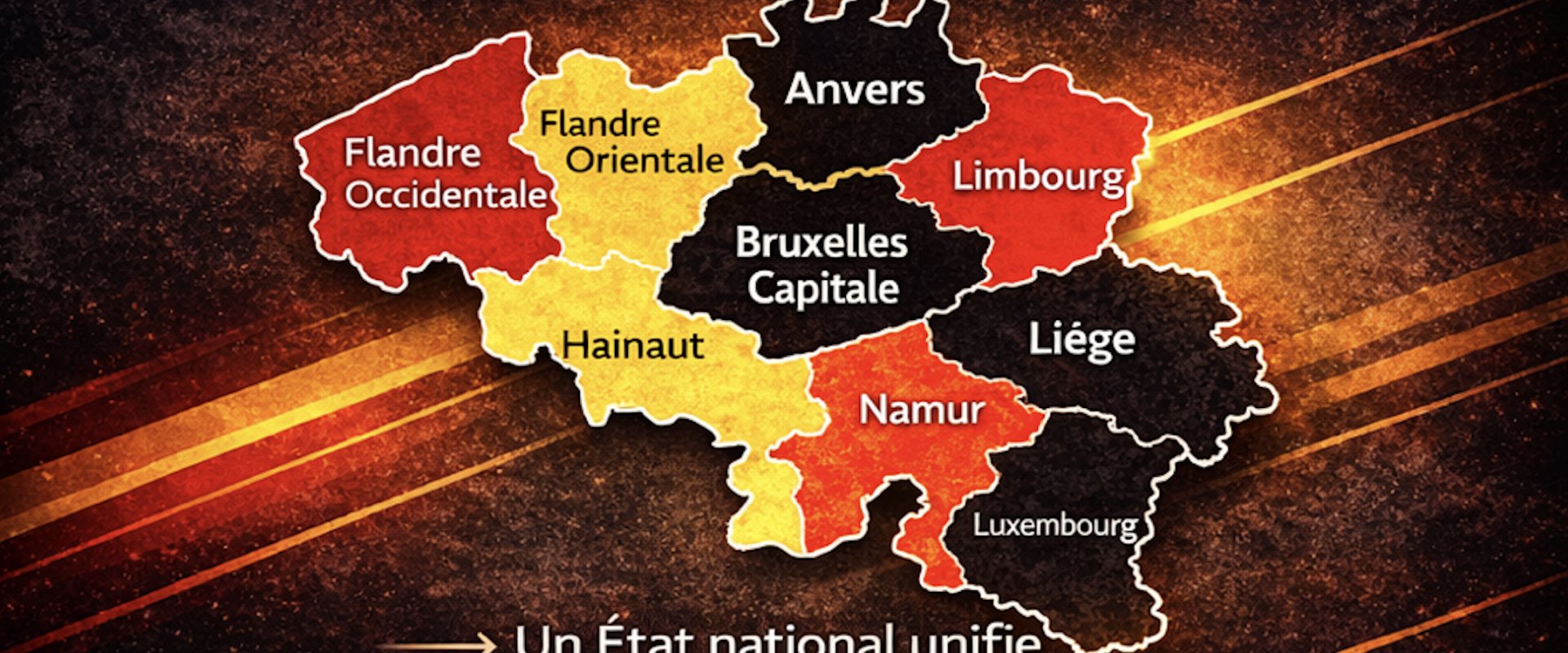
The 1993 reform transformed unitary Belgium into a federal State composed of Communities and Regions. We propose to abolish this reform in order to turn Belgium back into a unitary State divided into provinces: the 8 historical provinces and the creation of a Brussels Capital province encompassing Walloon Brabant, Flemish Brabant and the current Brussels-Capital Region.
The creation of this large Brussels Capital province is particularly logical: tens of thousands of Belgians live in Brabant and work every day in Brussels. They already form a single and unified living area (transport, jobs, housing, schools, hospitals, urban planning). A single province will allow coherent, efficient and unified management of all these issues, without the current duplications and community blockages.
The key points of the reform we propose:
• Abolition of Communities and Regions with positive legislative harmonization (in case of differing legislation, the most advantageous legislation for citizens will be applied).
• Return to a 3-level structure: national, provincial and municipal, with a new distribution of powers between the national and provincial levels.
• Creation of a large Brussels Capital Province encompassing Walloon Brabant, Flemish Brabant and the former Brussels-Capital Region. Abolition of the German-speaking Community and full integration of the eastern cantons into the Province of Liège. Gradual abolition of German as a national language. The eastern cantons were conquered through war, but instead of integrating this population, we turned it into an additional community, probably the most protected minority in the world with a government and Ministers for only 80,000 people. This is an economic aberration and a failure of integration. For reasons of efficiency and savings, and without any discrimination, German must gradually be replaced by French in the eastern cantons. This will happen through education. Of course, during the transition phase, every German-speaking citizen will be respected and will not suffer any discrimination. Artificial intelligence will be able to assist them in their administrative procedures in French.
• General introduction of the Citizens' Initiative Referendum (CIR) based on blockchain technology with appointment and dismissal by the people of national Ministers, the Prime Minister, provincial Ministers and Provincial Governors. Abolition of parliaments, political parties and career politicians. Each Minister will now come from civil society and be chosen by the people.
• National government reduced to 10 Ministers (NL-FR parity) + one Prime Minister responsible for sovereign powers: Interior, Justice, Defense, Foreign Affairs, Budget, Finance, but also Health and Social Support, Employment, Environment and Agriculture, and finally New Technologies and administrative simplification.
• Provincial government composed of 5 Ministers and one Governor responsible for the following competencies: education, culture, housing, sport, transport, mobility and infrastructure.
• Mandatory learning from a very young age of the two official languages – French and Dutch – so that future generations can truly understand each other and live in harmony.
• Imposition of full bilingualism throughout the entire territory: extension of language facilities to the whole country. Any citizen will be able to express themselves in French or Dutch in any public structure (administrations, courts, hospitals, schools, provincial services…) if necessary with the implementation of assistance based on artificial intelligence.
With such a state structure based on the will of the people, decisions will be more coherent and will better correspond to the real needs of the population.