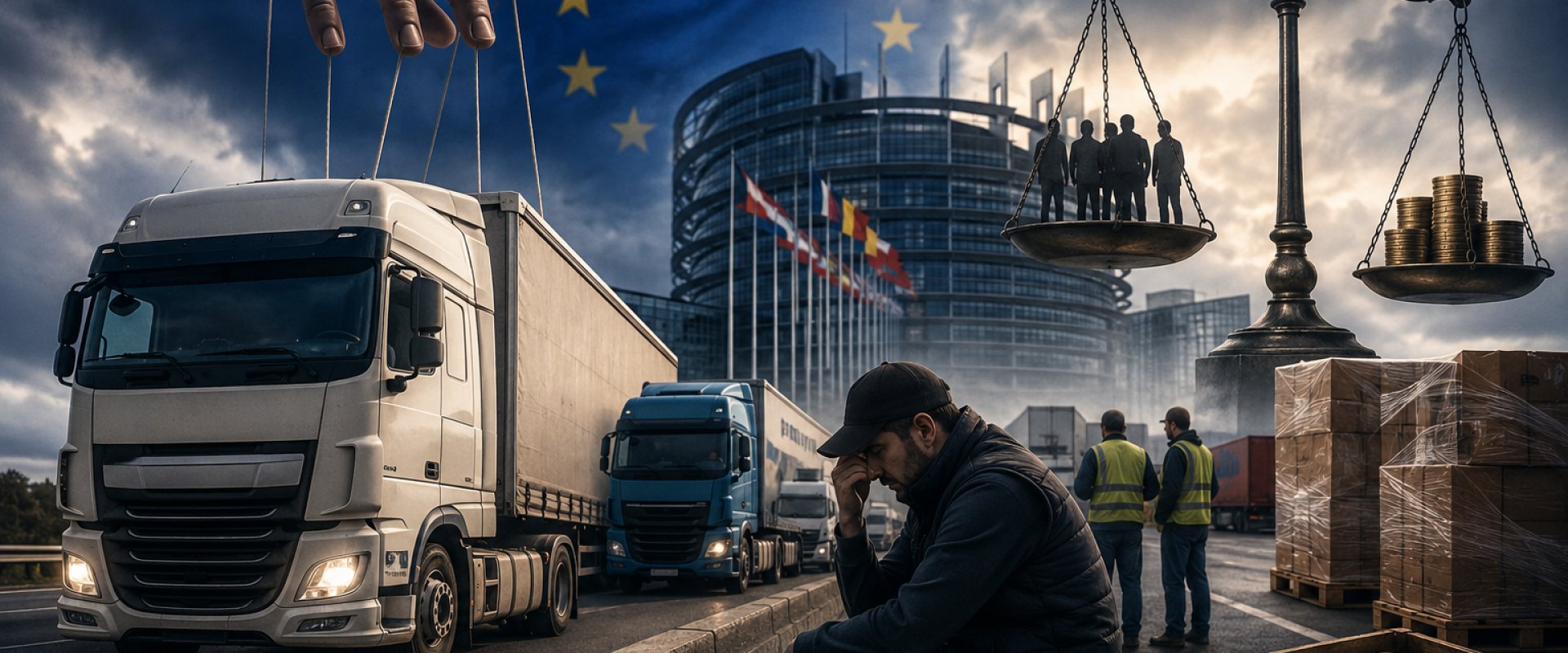
Dumping social transport: because Bruxelles is a protège of economic intérêts and détriment des travailleurs
In the sector of transport route, the dumping social is devenu the mode of operation. Les travailleurs le dénoncent. Les syndicats le dénoncent. Les inspectors le denounce. Les entreprises locales qui respectent les règles le dénoncent. Et pourtant, rien ne change...
A Europe That Promises Social Justice but Organizes Unfair Competition!
For decades, European institutions have repeated the same message: fair competition, worker protection, social harmonization, and shared economic progress.
Yet the reality experienced by thousands of truck drivers, independent transport operators, and small and medium-sized enterprises is entirely different.
In the road transport sector, social dumping has become a fully-fledged business model. Workers denounce it. Trade unions denounce it. Inspectors denounce it. Local companies that comply with the rules denounce it. And yet, nothing really changes.
Why?
Because behind the grand speeches about a “Social Europe,” the economic interests of certain groups often carry more weight than the concerns of citizens and workers.
Social Undercutting as a Driver of Competitiveness
What was supposed to be a common market has gradually become a market where social disparities are used as a competitive advantage.
Some large corporations have built their business models on:
- excessive subcontracting;
- exploiting wage differences between Member States;
- complex administrative arrangements;
- the constant optimization of social security contributions.
Meanwhile, the consequences are very real. Local businesses are closing their doors. Self-employed operators are giving up their activities. Drivers are working under increasingly difficult conditions. And public finances are deprived of revenues that are essential for funding our social protection systems.
The winners are few. The losers are millions!
Cabotage: From Exception to the Rule
Cabotage refers to the possibility for a foreign transport operator to carry out domestic transport operations within another European Union country after completing an international delivery there.
In practical terms, a Polish truck that delivers goods in Belgium may, before returning to its home country, carry out several transport operations between different Belgian cities. The original purpose of this rule was to avoid empty return trips, reduce logistics costs, and facilitate trade within the European market.
In principle, this measure may seem logical.
The problem is that some companies have gradually transformed this mechanism into a permanent tool for social optimization.
European regulations do limit cabotage. A foreign carrier may only perform a limited number of operations during a specified period after completing its international delivery.
However, in practice, many stakeholders in the sector report frequent circumventions through:
- shell companies;
- accommodation addresses used for administrative purposes;
- complex subcontracting chains;
- fictitious operational bases;
- various administrative manipulations.
As a result, some transport operators manage to conduct near-permanent activities in countries with higher social costs while continuing to benefit from the social charges and wage conditions of their country of origin.
For companies that comply with the rules and for local workers, this situation creates particularly unfair competition.
Brussels Under the Permanent Influence of Lobbyists
One of the major problems lies in the influence exercised by large economic interests over European decision-making.
Thousands of lobbyists operate around the institutions of Brussels.
Their presence is legal.
But their ability to influence policy raises a fundamental question: who is really defending the public interest?
Large multinational corporations have entire teams dedicated to regulatory influence.
SMEs, workers, and ordinary citizens obviously do not have the same resources.
The result is evident. Regulations are often watered down. Controls remain insufficient. Penalties are rarely proportionate to the stakes involved.
And while some speak of social justice, others are mainly concerned with protecting their profit margins.
Impunity That Fuels Public Anger
The real scandal is no longer merely the fraud itself. The real scandal is the lack of consequences for those who profit from it.
Drivers are inspected.
Small businesses are sanctioned.
But major contractors often seem to benefit from a form of economic and political protection.
They are the ones imposing ever-lower prices.
They are the ones driving pressure throughout the entire subcontracting chain.
They are the ones who benefit most from a system that has become deeply unbalanced.
This situation fuels a sense of injustice that extends far beyond the transport sector.
A Democratic Crisis That Continues to Grow
Social dumping has now become the symbol of a much deeper malaise.
Across Europe, many citizens feel that institutions listen more closely to organized economic interests than to the concerns of working people.
When the rules appear to favor the most powerful;
when workers feel sacrificed in the name of competitiveness;
when sanctions seem reserved for the weakest;
then trust in institutions gradually collapses.
And this distrust continues to grow.
The Time for Choices
The debate on social dumping now goes far beyond the sole issue of road transport.
It raises an essential question: WHO should be at the center of public policies?
Workers or markets?
SMEs or multinational corporations?
The real economy or short-term profit-driven logic?
As long as these questions remain unanswered, criticism of the current functioning of the European Union will continue to grow.
Because one thing is certain: no political project can endure for long when a growing share of the population feels that the rules of the game are written by the powerful and applied to the weak.
Révolution advocates for Belgium's withdrawal from the European Union by activating BelExit through Article 50 of the European Treaty.